

Fulfillment vs. Dropshipping: Which is the right choice for me?
Key takeaways from this guide
What is the difference between dropshipping and fulfillment?
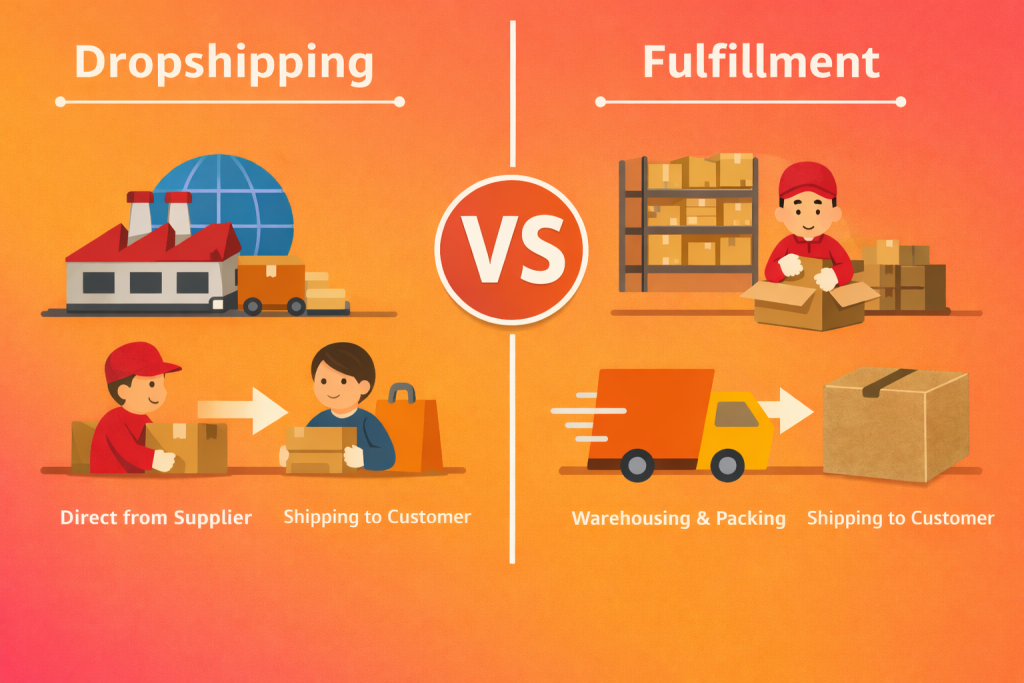
A key difference between dropshipping and fulfillment lies in the underlying business model. With dropshipping, you do not source or sell your own products. Instead, the shop owner purchases a service that includes both products and logistics from a dropshipping provider. As an online retailer, you are completely dependent on the dropshipping provider and their quality standards regarding products and logistics.
Shipping is usually handled directly by the manufacturer, often based abroad, which can result in delivery times of two weeks or more. Returns to foreign countries are also associated with additional costs. As a retailer, you only have limited influence on quality and execution. It is therefore essential to carefully evaluate which dropshipping provider you choose to work with.
Direct comparison: Dropshipping vs. fulfillment
When starting out as an online retailer, one common question arises: should we use dropshipping or work with a fulfillment partner? This question is valid but cannot be answered in a one-size-fits-all way. It is important to define the context and framework conditions in order to make a well-informed decision. Below, we take a closer look at the differences and examine individual logistics aspects in more detail.
Who owns the products?
With dropshipping, the products belong to the company that ships them. This means the online retailer does not own the goods being sold. You only pay fees for dropshipping services such as storage, shipping and returns, but not for the products themselves. This offers a clear cost advantage at the beginning, as no investment is required in products or warehousing.
In contrast, with fulfillment the online shop owns the products itself. The company only pays the fulfillment partner for the logistics services provided. As a retailer, you must source the products on your own, which increases the initial investment compared to dropshipping.
Starting capital: Low entry barriers vs. investing in efficiency
Beyond operational execution, the biggest difference lies in the required starting capital. Dropshipping enables online shops to enter the market at very low cost, as no own warehouse space or upfront investment in inventory is required. Products are shipped directly from the supplier to the end customer. The online retailer essentially acts as an intermediary.
In contrast, the traditional fulfillment model requires a higher initial investment. Goods are first procured, then stored, picked and shipped via a fulfillment service provider.
In return, retailers benefit from professional processes, greater planning reliability and higher customer satisfaction thanks to faster delivery times and transparent workflows.
Control: Those who manage logistics strengthen their brand
A key advantage of the fulfillment model is greater control over warehousing, shipping and returns management. Retailers can ensure that products are packaged correctly, delivered on time and that returns are processed efficiently.
When fulfillment is outsourced to a service provider, some control is delegated, but the brand experience can still be shaped more precisely through personalized packaging or value-added services.
With dropshipping, operational control largely rests with the supplier. Online shops have little to no influence over delivery times, packaging or quality assurance of products and shipping. Especially with international suppliers, this can lead to delays and, in the worst case, dissatisfied customers.
Scalability and long-term perspective
Dropshipping is well suited for a quick start in e-commerce or for testing new products. However, anyone aiming to build a brand and achieve stable long-term revenue will quickly reach limitations. The lack of control over products, inventory levels and delivery times makes sustainable growth more difficult.
Fulfillment, on the other hand, offers scalability and long-term growth when working with the right partner. As a professional fulfillment provider, PVS Europe flexibly adjusts storage and shipping capacities to your needs. This allows you to scale efficiently during peak seasons such as Christmas or Black Week, while maintaining your brand identity. This is a decisive advantage in the D2C business.
How do I choose between dropshipping and fulfillment?
Both models have their strengths and weaknesses. Dropshipping offers flexibility and low entry barriers, while outsourced fulfillment provides greater control and scalability. The right choice depends on your specific goals, resources and requirements regarding product quality and logistics.
You should also ask yourself: what is my business model and which products do I want to sell? Based on this, you can generally make the following decisions:
Dropshipping: Ideal for beginners, niche products and fast market tests with very little or no starting capital. No own warehouse is required and products do not need to be sourced.
Fulfillment: Worthwhile for shops with a growing order volume and a focus on reliable logistics. Working with a fulfillment service provider ensures fast delivery and reliable returns management. Inventory levels can be monitored at any time to avoid bottlenecks in the online shop.
Outstanding fulfillment by PVS

Estefania ist seit 2021 Teil des Online-Marketing-Teams bei PVS. Mit ihrem Know-how in E-Commerce und Fulfillment bringt sie komplexe Themen verständlich auf den Punkt. Sie liebt es, neue digitale Trends aufzugreifen und daraus Inhalte zu entwickeln, die Händlerinnen und Marken wirklich weiterbringen. In ihren Beiträgen geht es nicht nur um Fakten, sondern auch um Inspiration für alle, die im E-Commerce durchstarten wollen.